
















 Email Support:
 WhatsAPP:
Whether you run a butcher shop, a restaurant kitchen, a sausage-making facility, or a meat processing plant, knowing how to use a commercial meat grinder correctly is essential — not just for output quality, but for food safety, equipment lifespan, and staff safety. Unlike home kitchen grinders, commercial units process much larger volumes of meat under continuous duty cycles, which means operating procedure, hygiene, and maintenance routines matter far more.
This guide walks through the parts of a commercial meat grinder, step-by-step operating instructions, food-safety best practices, and how to choose the right grinder capacity for your business.
Who This Guide Is For
This guide is written for:
- Restaurant and butcher shop owners processing meat in-house
- Sausage and deli product manufacturers
- Meat processing plants and cold-chain food factories
- Anyone evaluating whether to invest in a tabletop, floor-standing, or industrial frozen meat grinder
If you’re looking for a simple guide to a small home kitchen attachment, this article focuses instead on commercial-grade equipment used in professional food production environments.
Key Parts of a Commercial Meat Grinder
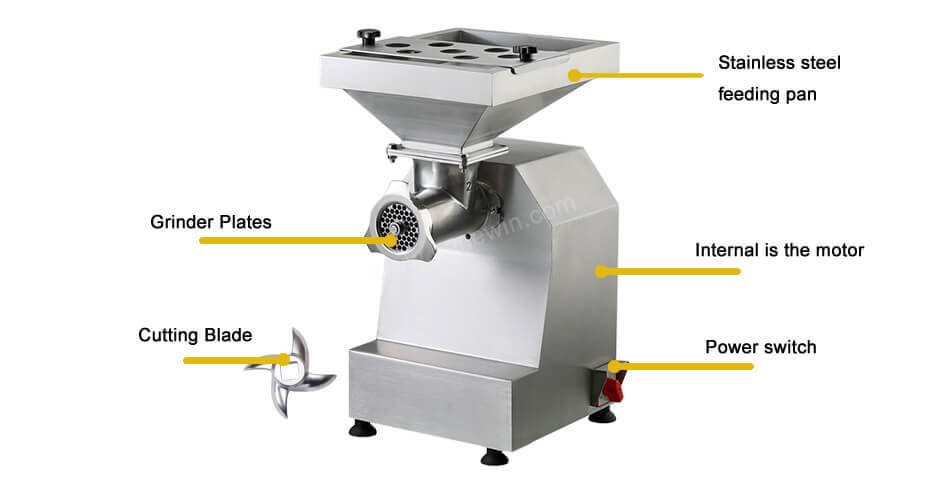
Understanding the main components helps you operate the machine safely and troubleshoot issues faster:
- Hopper / Feed Tray — Holds the meat before it enters the feed tube. Commercial hoppers are sized for continuous, high-volume feeding rather than single batches.
- Feed Tube / Throat — Where meat is guided toward the cutting mechanism. Diameter varies by machine size (commonly labeled #22, #32, #42, etc.).
- Pusher / Plunger — Pushes meat into the feed tube. Commercial machines require using the pusher at all times — never your hands — for safety compliance.
- Auger (Worm Screw) — Moves and compresses meat toward the cutting blade.
- Cutting Blade — Cuts meat into the desired grind size.
- Grinding Plates (Dies) — Interchangeable plates that determine coarseness; commercial operations typically stock multiple plate sizes (e.g., 3mm, 8mm, 13mm) for different products.
- Motor & Gearbox — Commercial units use industrial-grade motors rated for continuous operation (often 1.5HP–15HP depending on capacity), unlike intermittent-duty home motors.
Step-by-Step: How to Operate a Commercial Meat Grinder
1. Pre-Chill the Meat and Equipment
Meat should be chilled to approximately 0–4°C (32–39°F) before grinding, and semi-frozen meat (partially frozen, firm to the touch) produces the cleanest cut with less smearing. For frozen meat grinders, blocks can be processed at lower temperatures directly — check your machine’s rated input temperature range.
2. Trim and Cut Meat to Size
Remove excess sinew, cartilage, and large bone fragments. Cut meat into strips or cubes sized to feed easily into the throat without forcing or jamming.
3. Assemble and Inspect the Grinder
Confirm the auger, blade, and grinding plate are correctly seated and tightened per the manufacturer’s assembly sequence. A loose or misaligned blade is one of the most common causes of smeared, mushy output and premature wear.
4. Select the Correct Grinding Plate
Choose plate size based on your end product — coarser plates (10–13mm) for chili or coarse sausage, finer plates (3–5mm) for hot dogs, pâté, or emulsified products.
5. Feed Meat Steadily Using the Pusher
Feed meat at a consistent, moderate pace using the pusher — never your hands or other tools. Overloading the hopper causes the motor to strain and can lead to overheating or jamming.
6. Monitor Output and Temperature
For extended production runs, monitor meat temperature periodically. If the meat starts to smear (looks pasty rather than distinct strands), stop and check whether the blade needs sharpening or the meat has warmed too much.
7. Double-Grind When Needed
For fine, uniform textures (e.g., sausage emulsions), pass the meat through the grinder twice — once through a coarse plate, then again through a fine plate — chilling between passes if the run is long.
8. Shut Down and Disassemble for Cleaning
Turn off and unplug/lock out the machine before disassembly. Remove the plate, blade, and auger for cleaning immediately after each production run.
Food Safety and Sanitation (Critical for Commercial Operations)
Commercial meat grinders fall under food-safety regulations (e.g., HACCP, local health codes) that home appliances don’t need to meet. Key practices:
- Clean after every production run, not just at end of shift — bacteria multiply quickly on meat residue.
- Disassemble fully — auger, blade, and plates should be washed separately in hot soapy water, sanitized, and air-dried.
- Never leave meat sitting in the hopper or feed tube between runs.
- Follow a documented cleaning log if you’re subject to health inspections or HACCP audits.
- Inspect blades and plates for pitting or rust, which can harbor bacteria and contaminate product.
Maintenance Schedule to Extend Equipment Life
| Frequency | Task |
|---|---|
| After every use | Disassemble, clean, and sanitize all meat-contact parts |
| Weekly | Inspect blade sharpness; check for play/looseness in the auger |
| Monthly | Lubricate designated grease points (per manufacturer manual); inspect gearbox oil level |
| Quarterly | Sharpen or replace blades and plates; inspect drive belt/coupling wear |
| Annually | Full motor and gearbox inspection by a qualified technician |
Well-maintained commercial grinders (like Newin’s stainless-steel range) can run reliably for 8–10+ years in daily commercial use; neglected maintenance is the leading cause of premature motor failure and inconsistent grind quality.
Common Problems and Quick Fixes
- Meat coming out smeared/pasty instead of clean strands → Blade is dull or meat is too warm. Re-chill meat and check/sharpen the blade.
- Grinder jams frequently → Meat pieces are cut too large, or too much sinew/connective tissue is present. Trim more thoroughly and cut smaller.
- Motor overheats or trips breaker → Overfeeding, or grinding meat that’s too warm/fatty for the plate size selected.
- Uneven grind texture → Worn or mismatched blade-to-plate fit; replace as a matched set rather than individually.
Choosing the Right Commercial Meat Grinder for Your Business
Capacity and machine type should match your production volume:
- Tabletop grinders (~100–300 kg/h) — suited to small butcher shops, restaurants, and delis
- Floor-standing/industrial grinders (~500–2,000+ kg/h) — suited to mid-size processing operations and central kitchens
- Frozen meat grinders — designed to process meat blocks directly from frozen (down to around -25°C), reducing labor and thawing time for high-volume plants
When evaluating equipment, consider: required output per hour, available grinding plate sizes, motor duty cycle rating, ease of disassembly for cleaning, and after-sales technical support — especially important when importing equipment internationally.
Frequently Asked Technical Questions
Q: How often should I sharpen my commercial meat grinder blade?
A: Under daily commercial use, blades typically need sharpening or replacement every 1–3 months depending on volume and meat type; sharpen sooner if you notice smearing.
Q: Can a commercial meat grinder process frozen meat?
A: Standard commercial grinders require partially thawed or semi-frozen meat. Dedicated frozen meat grinders are built with reinforced augers and motors specifically to cut fully frozen blocks.
Q: What size commercial meat grinder do I need for a small restaurant?
A: Most small-to-mid restaurants are well served by a tabletop unit in the 100–300 kg/h range; higher-volume central kitchens or processors typically need floor-standing models rated 500 kg/h or above.
Q: How do I keep a commercial grinder compliant with food safety regulations?
A: Disassemble and sanitize all meat-contact parts after every production run, maintain a documented cleaning log, and inspect blades/plates regularly for pitting or rust that can harbor bacteria.
Need Help Choosing the Right Equipment?
Newin has supplied commercial and industrial meat processing equipment to food businesses worldwide since 2013. If you’d like guidance on selecting the right grinder capacity, plate configuration, or frozen-meat processing setup for your operation, request a free consultation and quote from our engineering team.

Newin SJ02T 2T/h Industrial Sugar Cane Juicer
Newin SJ01T 1T/h Industrial Sugar Cane Juicer
Newin QD-550 Commercial Meat Dicing Machine – 700–900 kg/h
Newin QD-350 Meat Dicing Machine for Fresh & Frozen Meat
Newin DMS-201 Multi-Functional Meat Grinder & Cutter Machine
Newin DM-32 Industrial Stainless Steel Commercial Meat Grinder (DM-12 / DM-22 / DM-32)
Newin NW-250KS Tabletop Commercial Bone Saw Machine
Newin NW-310K Variable Speed Floor-Type Bone Saw Machine
Newin NW-250CC Floor-Type Commercial Bone Saw Machine
Newin NW-250CE Tabletop Stainless Steel Bone Saw Machine
Newin NW-PF1S Square Pan Commercial Rolled Ice Cream Machine
Newin NW-PF1R Single Round Pan Thai Rolled Ice Cream Machine